Some crystals are world travelers.
Quartz, for example, shows up on nearly every continent. Amethyst forms in caves and volcanic pockets worldwide. These crystals are not ordinary by any stretch. Quartz points can grow into breathtaking formations, and amethyst geodes can stop people in their tracks.
Just because something is common does not make it less incredible. It simply means the Earth figured out how to make it more than once.
But every now and then, something very different happens.
A specific combination of temperature, chemistry, pressure, and time comes together in one small place on the planet. The conditions are so precise that the process never repeats itself anywhere else.
Those rare moments in Earth's history create stones found nowhere else.
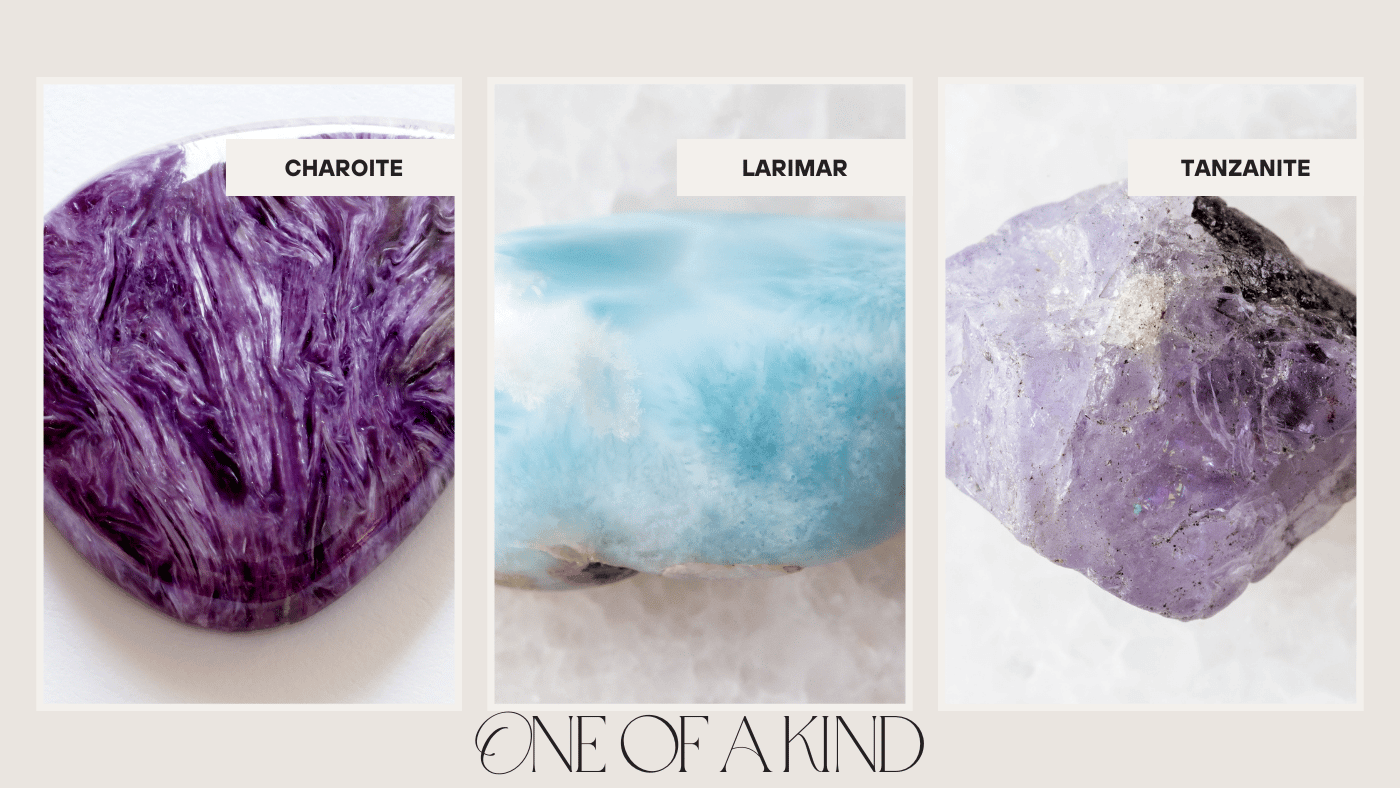
Today, we are looking at three of those stones and the places that shaped them: Charoite from Siberia, Larimar from the Dominican Republic, and Tanzanite from Tanzania.
Mini Crystal Stud Earrings | Handmade Crushed Crystal Silver Studs
$25.00
Crushed Crystal Stud Earrings Triangles | Circles | Drops Small shapes. Natural sparkle. These earrings feature natural crushed gemstones layered in clear resin, creating depth, texture, and a soft shimmer that catches the light throughout the day. Each pair highlights… read more

Charoite: The Siberian River Rock That Stops People in Their Tracks
Charoite comes from a remote region of Siberia known as the Murun Massif, which contains a surprising number of rare minerals. The stone is named after the nearby Chara River.
A stone often mistaken for Amethyst at my jewelry booth, in its crushed form, has a color so deeply purple that many people assume it must be dyed or enhanced. I will admit that the first time I encountered Charoite, I wondered the same thing. The purple is incredibly rich, and the swirling patterns look almost painted.
So I did what many curious people do. I went down the research rabbit hole.
Charoite formed through a rare geological process called metasomatism. Millions of years ago, molten igneous rock forced its way into ancient limestone deposits. The intense heat and chemical exchange between these rocks created an entirely new mineral environment.
Within that environment, tightly woven fibrous crystals began forming together, creating the swirling patterns that make Charoite so distinctive.
The wider world first became aware of the stone in the 1940s when railway workers blasting tunnels for the Trans-Siberian Railway encountered unusual purple rock. When samples eventually reached the international gem community, many experts believed the color had to be artificial, much like I did when I found this beautiful stone. It was simply too vivid to seem natural, but no, that purple is real!
Charoite was not officially recognized as its own mineral until 1978.
Local traditions in the region tell of Mongolian communities placing the stone in boiling water, believing that the mineral strengthens family bonds and community ties. Modern mineral science tells us the stone can contain trace elements like barium and manganese, so today we appreciate Charoite for its beauty in jewelry rather than as a tea ingredient.
Energetically, many people associate Charoite with navigating deep personal transformation. Considering the intense pressure and chemical change that created it, that interpretation makes a lot of sense.
Larimar: Fire That Somehow Looks Like Water
Larimar is one of those stones that feels like it carries the landscape where it formed.
This soft blue variety of the mineral pectolite is found only in a small mountainous region of the Dominican Republic. Its colors resemble the calm blues and whites of Caribbean water, yet the stone itself was created by volcanic activity.
Larimar forms deep within volcanic rock cavities. As mineral rich gases cooled inside these ancient volcanic tubes, crystals began to form. Over time, the chemistry and temperature created blue and white patterns that look remarkably like moving water.
For generations, local residents had noticed bright blue stones appearing in rivers after heavy rains.
In 1974, Dominican artisan Miguel Méndez and Peace Corps volunteer Norman Rilling traced those river stones back to their source in the surrounding mountains. Today, the entire global supply of Larimar still comes from that one small region.
Whenever I hold Larimar, I always find it a little funny that a stone that looks so calm and ocean-like was actually born from volcanic fire. I call it my Goddess stone. Formed through fire, Earth and cooled with air, reflecting the serenity of calm water.
A reminder that the most peaceful looking things can come from surprisingly intense spaces.
Because of its calming colors and origin story, Larimar is often associated with clear communication and emotional balance. Many people find it helpful as a reminder to slow down, breathe, and say what they truly mean.
Tanzanite: A Geological Accident Near Kilimanjaro
Tanzanite is also a relatively recent discovery in the world of gemstones.
This blue and violet variety of the mineral zoisite is found in a very small mining area in the Merelani Hills of northern Tanzania near Mount Kilimanjaro. The entire known deposit covers only about eight square miles.
The conditions that created Tanzanite were remarkably specific.
Around 585 million years ago, tectonic plate collisions reshaped the region during the Pan-African orogeny, a period of mountain building. The heat and pressure from those collisions, combined with the rare presence of the element vanadium, which entered the crystal structure and produced the vivid blue violet colors we see today.
Tanzanite also has a fascinating optical quality known as pleochroism. Depending on how light enters the crystals, the stone can shift between blue, violet, and sometimes hints of burgundy.
The stone was discovered in 1967 when a Maasai tribesman named Ali Juuyawatu directed a local prospector to a cluster of brilliant blue violet crystals lying on the ground.
Soon after, Tiffany & Co. introduced the stone to the global market and named it Tanzanite after its country of origin.
In Maasai culture, the color blue represents new life, and blue stones are traditionally gifted to women who have recently given birth. Because of this history and its shifting colors, Tanzanite is often associated with transformation and new beginnings.
Three Crystals, Three Very Different Places
When you step back and think about these crystals together, something interesting comes to mind about transformation, communication, and the shared moments that can sometimes feel rare.
Charoite formed through chemical transformation deep swithin Siberian rock.
Larimar crystallized inside volcanic cavities in the Caribbean.
Tanzanite emerged from tectonic collisions in East Africa.
Sometimes a specific combination of geology, chemistry, and timing comes together in one place, producing something that will never form anywhere else.
Holding one of these stones can feel like holding a small reminder to cherish the rare moments, even when the road to get there was intense and unknown. The outcome can be a beautiful one-of-a-kind experience.
Time to Nerd Out: Why So Many Rare Stones Come From Ancient Mountain Collisions
Geologists have noticed an interesting pattern when studying rare minerals.
Many of the world's most unusual stones occur in regions shaped by ancient mountain-building events.
When tectonic plates collide, the Earth's crust folds, melts, and mixes together under enormous pressure. Rocks that were never meant to interact suddenly combine. New chemical reactions occur, and minerals form that would never appear under ordinary conditions.
You could think of these places as the Earth's experimental kitchen.
Most of the time, the planet is making familiar recipes.
But every once in a while, something unexpected happens underground, and millions of years later, we are enchanted by the result.
Want to go deeper? Check out https://www.mindat.org/
A Thought to Sit With
Nature has a funny way of reminding us that rarity is not about perfection.
It is about the right conditions coming together at the right moment.
Sometimes that happens deep within the Earth.
Sometimes it happens in our own lives.
And every once in a while, when timing, process, and the right components align, something remarkable is created.
Those moments are rare; they are also a little majestic, and we are fortunate to witness them.